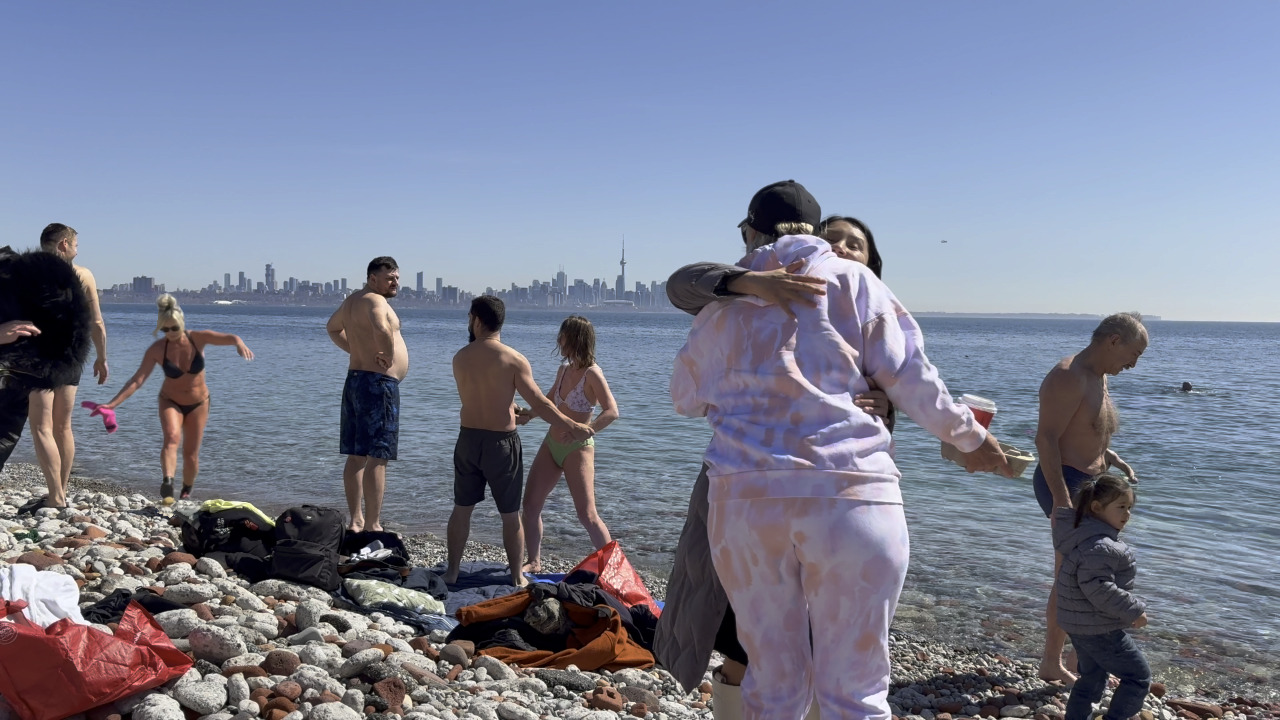
Still (composite) from the video A Clean Place to Swim (Ukrainians), 27 mins. Diane Borsato, 2025.
Curated by Jacqueline Bell
In A Clean Place to Swim, Diane Borsato presents new and past works that explore the liberating, intimate, and communal possibilities of being in the water. Acts of teaching and learning, encounters across backgrounds, as well as illustrations of our shared right to clean natural environments, commingle in works made in lakes, rivers, hot springs, and community pools.
At the entrance of the exhibition is Floats, Holds, Strokes, 2026, a new video in which the artist, together with dancers Naishi Wang and Lukas Malkowski, considers the gestures inherent to swimming lessons to create movement experiments recorded in the dance studio. In choreographies of floating, support, and synchronized breath, the work explores the physical poetics of moving in water.
A Clean Place to Swim (Ukrainians), 2025, and A Clean Place to Swim (Snow), 2026, record a group of Ukrainian Canadians who meet regularly at Lake Ontario in Toronto to swim together all year long—without regard to weather or water quality—in scenes of both joy and defiance. The title of these works and the exhibition are adapted from a line in The Culture of Nature, 1991, by Alexander Wilson.
In Pools, 2014, photographs of the artist’s family swimming together in geothermal waters across Iceland, foreground moments of anxiety and tenderness in the context of a sensitive and changing environment.
In Swimming with Mathematicians, 2018, made in Banff during a heatwave, the artist invited mathematicians from the Banff International Research Station (BIRS) to swim together with resident artists in the Bow River’s cold waters. Despite different personal and professional worlds, diverse participants shared an unlikely, conscious moment together in the landscape.
Finally, in Borsato’s new dual-channel video installation, Swimming Lessons (Mom/Dad), 2026, the artist put her recent certification as a swimming instructor to work by teaching both her mother and father to swim. In the intimate footage we see how hierarchies in family relationships might be suspended in the water, while other dynamics are magnified by it.
In all of the works in A Clean Place to Swim, swimmers embody new possibilities for relating to one another and with the wider world.
Walter Phillips Gallery gratefully acknowledges the ongoing support of the Canada Council for the Arts, and the Province of Alberta through Alberta Foundation for the Arts.
The artist would like to extend special thanks to Jacqueline Bell, Amish Morrell, Banff Centre for Arts and Creativity and the Canada Council for the Arts.